


The question every marketing team is asking right now
The SEO playbook most companies are running right now was written for a search engine that is no longer the only one that matters.
A client asked us recently what we’re doing differently to optimize for AI search. What they were really asking: do we need a new set of tactics?
The present-day answer: Yes, if you have a justifiable need and a commensurate budget to feed traditional search (Google and Bing) and AI-based search optimization.
How AI search works differently
AI platforms don’t retrieve the best-ranked page. They synthesize answers from sources that demonstrate genuine expertise: published thought leadership, detailed analysis, well-cited research, writing that reflects real experience. The content they trust isn’t built around terms. It’s built around how buyers actually think through a decision: what criteria matter, what tradeoffs exist, what can go wrong.
That’s a different job than ranking for keywords.
Most brands haven’t made that shift. They’re still optimizing for discoverability in a system that’s no longer the whole game. Meanwhile, the companies publishing decision-grade content — the kind that shapes how someone thinks, not just what they find — are becoming the sources AI platforms consistently cite.
The brands winning in AI search right now didn’t pivot when ChatGPT launched. They started publishing decision-grade content months, sometimes years, before it mattered. That gap is real. But it’s still closeable.
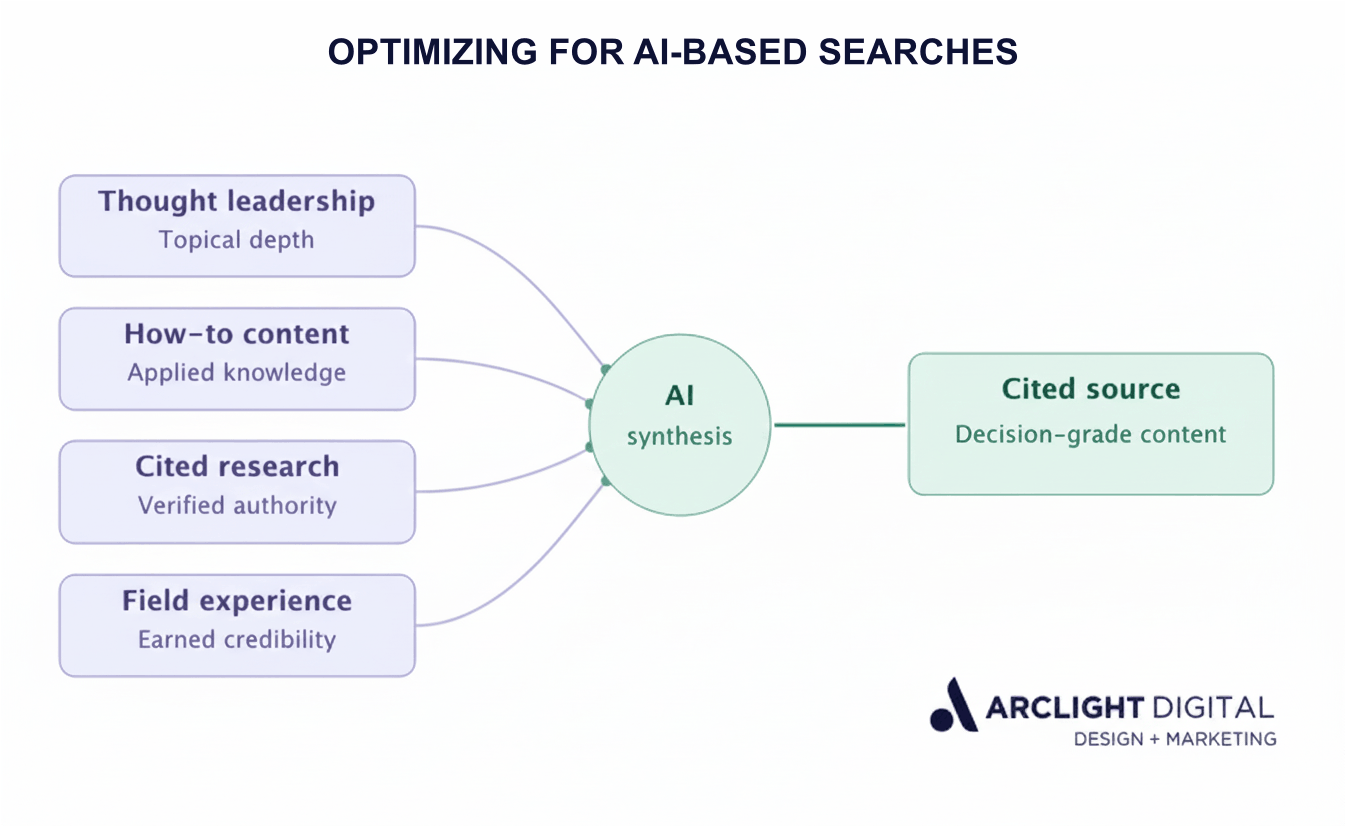
What AI search is actually looking for
From the chart above, “Field experience: Earned credibility” is the area that generates the most questions. Real-world experience shows up in content in ways that AI search engines have gotten surprisingly good at detecting. Not through a single signal, but through a cluster of them that surface-level content can’t fake.
Here is a five-point breakdown of what it actually looks like.
1. Specificity that only comes from doing the work
Generic content says “make sure your website loads fast.” Experienced content says “we’ve found that anything above 2.8 seconds on mobile kills conversion for service-based businesses. Not because of the bounce, but because it signals to the visitor that the company doesn’t sweat the details.” The second version has a number, a context, a consequence, and an observation that came from watching it happen.
2. Named failure modes
People who have done the work know what goes wrong and when. Content that describes specific failure scenarios (not hypothetical ones, but “this is what happens when you skip this step”) reads as earned knowledge rather than researched knowledge.
3. Calibrated caveats
Experienced writers qualify things. They say “this works for most B2B service businesses but breaks down for e-commerce because the purchase intent is different.” That kind of nuance doesn’t come from reading about a topic. It comes from running into the edge cases.
4. Process detail that doesn’t appear in the documentation
The unofficial steps. The workarounds. The things that technically work but nobody recommends. The context around when a best practice stops being best.
5. Opinions with a basis
Not “some experts believe” but “we stopped recommending X in 2022 because we kept seeing Y happen to clients who did it.” AI platforms are increasingly distinguishing between content that reports consensus and content that has a point of view rooted in experience.
The underlying reason AI search responds to this: it’s trained to surface answers that are most likely to be accurate and complete. Content that carries the markers of real experience is statistically more likely to be right, and less likely to be generic filler written to a keyword brief.
Traditional Organic SEO still matters, and here’s why
None of this makes traditional organic SEO obsolete. Google and Bing remain the dominant search channels for most businesses, and the fundamentals that drive rankings there — technical site health, keyword-aligned content, authoritative backlinks, and on-page optimization — are as important as ever. A well-executed organic SEO strategy is still the most reliable, cost-efficient way to build sustainable visibility in traditional search.
What’s changing is the landscape around it. Generative AI search (the answers surfaced by platforms like ChatGPT, Perplexity, and Google’s AI Overviews) is still evolving rapidly and remains genuinely unpredictable. Citation patterns shift, platform behaviors change, and no one has fully cracked the code yet. The smartest approach right now is to treat AI search optimization not as a replacement for organic SEO, but as a complementary investment: keep building the keyword authority that drives Google rankings while layering in the decision-grade, experience-rich content that earns trust with AI platforms. Both matter. The brands that treat them as either/or are leaving ground uncovered.